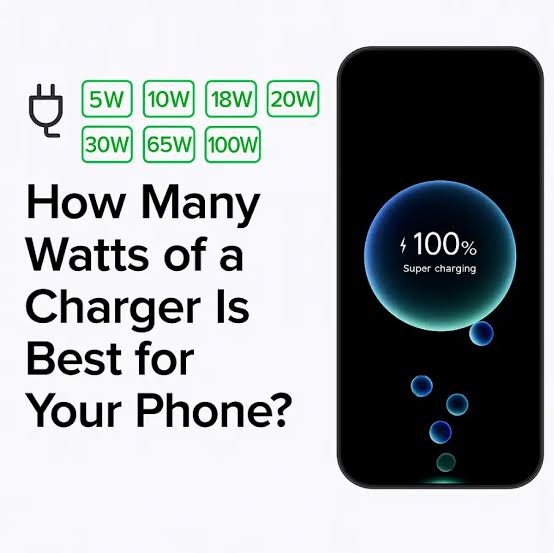
When buying a new phone charger, one of the first things you probably look at is the wattage. At first, the choice may seem simple: a 45W charger should be faster than a 25W charger, and a 65W charger must be even better. However, higher wattage does not always mean faster charging for your phone.
Charging speed depends on several factors working together, including the maximum charging power your phone supports, the charger's output, the charging protocol, and the cable. So, if your phone supports a maximum charging speed of 25W, connecting it to a 65W charger will not suddenly make it charge at 65W.
So, how many watts does your phone need for fast charging? The answer varies from one device to another. Some phones can achieve fast charging with 20W or 25W, while others can take advantage of 45W, 65W, or even higher charging speeds.
In this guide from Cart, we will explain how to determine the right charging wattage for your phone, compare common charger wattages, explain when buying a more powerful charger makes sense, and show you why your phone may still charge slowly even when using a fast charger.
How Many Watts Does Your Phone Need for Fast Charging?
There is no single wattage that can be considered the best charging power for every smartphone. The right wattage is the maximum power your phone can accept using a compatible charging technology.
For example, if your phone supports charging at up to 25W, a compatible 25W charger may already be enough to reach its maximum supported charging speed. Using a 45W or 65W charger will not necessarily make it charge faster.
As a general guide, common charging wattages can be understood like this:
|
Charging Power |
What Does It Mean in Practice? |
|
5–10W |
Traditional and relatively slow charging |
|
15–20W |
Suitable for faster charging on many phones |
|
25–30W |
Common fast-charging range for many modern devices |
|
45W+ |
Suitable for devices that support higher charging power |
|
65W+ |
Useful for certain devices or for charging multiple devices with one charger |
These figures are only general guidelines. Actual charging performance depends on your phone, charging protocol, charger, and cable.
So, before buying a new charger, do not only ask, "How many watts can this charger provide?" Also ask, "How many watts can my phone actually use?"
What Does Wattage Mean on a Phone Charger?
A watt (W) is a unit used to measure electrical power. It is the number you commonly see in charger specifications, such as 20W, 25W, 45W, or 65W.
Electrical power can be calculated using a simple formula:
Watts = Volts × Amps
For example, if one charging mode provides 9 volts at 3 amps, the resulting power is 27 watts.
As a user, however, you do not need to calculate volts and amps every time you buy a charger. What matters most is knowing how much power your phone supports, how much power the charger can provide, and whether the charging technologies used by both devices are compatible.
Does Higher Wattage Mean Faster Phone Charging?
Not necessarily.
Your phone determines how much power it can accept based on its design and supported charging technologies. You cannot force a phone designed for 25W charging to accept 65W simply by connecting a more powerful charger.
What Happens If You Use a 65W Charger With a Phone That Supports 25W?
When the charger and phone are compatible, the device uses an appropriate power level rather than automatically consuming the charger's full capacity.
Put simply, seeing 65W on a charger means the charger is capable of delivering up to that level under supported conditions. It does not mean that every device connected to it will charge at 65W.
Therefore, if your phone supports 25W, replacing a compatible 25W charger with a 65W model will not necessarily make the phone charge any faster.
A 65W charger can still be a practical choice if you want one charger for your smartphone, tablet, laptop, or several different devices.
If you want to compare different options, explore PD & Fast Chargers on Cart and choose a wattage that matches your devices.
Can a Higher-Wattage Charger Damage Your Phone?
Using a reliable and compatible charger with a higher maximum wattage than your phone supports does not mean the phone will automatically receive the charger's full output.
However, that does not mean every high-wattage charger is a good choice.
When buying a charger, pay attention to product quality, safety features, supported charging protocols, and cable quality, rather than focusing only on wattage. A poor-quality charger or cable can be a bigger concern than simply choosing a charger with more power than your phone requires.
The better approach is always to choose a reliable charger that is compatible with your device's specifications.
How Do I Know How Many Watts My Phone Supports?
If you are unsure about the right charging power for your device, do not rely on guesswork or simply look at the wattage printed on an old charger. There are several better ways to find out.
Check Your Phone's Official Specifications
Start with the manufacturer's official website and find your exact phone model. Then check its battery and charging specifications.
Look for terms such as:
Fast Charging – Wired Charging – Charging Power – Super Fast Charging
Make sure you check the exact model, as two phones within the same product family can support different charging speeds.
Check the Original Charger's Specifications
If your phone originally came with a charger, check the Output information printed on the adapter to see the power levels it can provide.
However, do not rely on this method alone, especially since many modern smartphones are now sold without a charger in the box.
Identify the Charging Technology Your Phone Uses
Knowing that your phone supports 25W or 45W is not always enough. You should also make sure that the charger supports the charging technology required by your device.
This is where standards and technologies such as PD, PPS, and Quick Charge become important.
How Many Watts Do iPhones Need for Fast Charging?
The charging power an iPhone can take advantage of varies depending on the model.
Modern iPhones support fast charging when used with a suitable USB-C power adapter and cable, but charging requirements and real-world performance differ between generations.
For this reason, you should not rely on a general rule such as "every iPhone needs a 20W charger." Different models may benefit from different charging capabilities, so it is better to check the specifications of your exact iPhone before buying a charger.
If you need a fast USB-C adapter, you can explore chargers and cables on Cart and compare different wattages based on your device rather than choosing a charger simply because it has the highest number.
How Many Watts Do Samsung Phones Need for Fast Charging?
Samsung Galaxy phones support different charging levels, including Fast Charging and Super Fast Charging.
Some compatible Galaxy devices support 25W charging, while certain models can take advantage of 45W charging.
That means owning a modern Samsung phone does not automatically mean you need a 45W charger.
If your phone supports a maximum of 25W, buying a 45W charger will not make the device charge at 45W. If your Galaxy supports 45W charging, the charger, charging protocol, and cable must also be compatible to achieve the supported performance.
How Many Watts Do Google Pixel Phones Need?
Charging power also varies between Google Pixel models. Modern Pixel devices use USB-C charging standards such as USB Power Delivery, while certain devices also use PPS for more flexible power delivery.
When choosing a charger for a Pixel phone, therefore, do not simply look for a high number such as 45W or 65W. Check the recommended charging power for your exact model and the charging protocols supported by the charger.
The same principle applies to other smartphone brands, including Xiaomi, HONOR, and many modern Android devices.
What Is the Difference Between 20W, 25W, 45W, and 65W Chargers?
Different wattage ratings can make buying a charger confusing, especially when dozens of options are available. Instead of automatically choosing the largest number, consider the device you actually want to charge.
20W Charger
A 20W charger can be a practical choice for many smartphones that do not require extremely high charging power. It can also provide fast charging for compatible iPhone models when the other requirements are met.
If your phone cannot take advantage of more than 20W, buying a 65W charger purely to charge that phone may not provide a meaningful speed advantage.
25W Charger
A 25W charger may be ideal for devices with a maximum supported charging power of around 25W, a level commonly found in a number of Samsung Galaxy phones and other smartphones.
If your phone supports 25W, the priority should be choosing a compatible 25W charger, rather than simply looking for a charger with a higher wattage.
45W Charger
A 45W charger makes more sense when your smartphone actually supports charging at that level or when you want a charger that can work with multiple devices.
Remember that the cable and charging protocol also need to be compatible.
65W Charger
A 65W charger can be an excellent option if you want to use one charger for multiple devices, particularly if you own a smartphone, tablet, or USB-C laptop.
However, if you only need to charge a phone with a maximum charging power of 20W or 25W, switching to 65W alone will not automatically double its charging speed.
You can browse Cart's chargers and cables collection to compare different wattages, ports, and charging technologies before choosing the right charger.
Why Isn't Your Phone Charging at Full Speed With a Powerful Charger?
You may buy a charger that matches your phone's supported wattage and still find that charging is slower than expected.
In that case, wattage may not be the problem.
Your Cable Does Not Support the Required Power
The cable is not simply a connection between the charger and phone. It is an important part of the entire charging system.
If your phone and charger can handle higher power but the cable cannot, you may not reach the expected charging speed.
This is why you may see cables rated for different power levels, such as 60W, 100W, or 240W. However, you should choose a cable based on your device and charging standard rather than simply buying the cable with the biggest number.
Explore charging cables available on Cart to find a cable that matches your charger and devices.
The Charger Does Not Support Your Phone's Charging Protocol
Two chargers may both be labeled 45W but deliver different results when connected to the same smartphone.
That is because wattage is not the only factor. The phone and charger also need to support compatible charging technologies.
Some of the most common fast-charging technologies include:
USB Power Delivery (PD)
Programmable Power Supply (PPS)
Qualcomm Quick Charge (QC)
If you want to understand these technologies in more detail, read our guide on PD vs. PPS vs. Quick Charge to understand why choosing the correct charging protocol can be just as important as choosing the right wattage.
Your Phone Is Too Hot
Temperature can directly affect charging performance. If the device becomes too warm, its battery management system may reduce charging power to protect the battery and internal components.
That is why your phone may charge quickly at first and then slow down as its temperature increases.
You Are Using the Phone While Charging
Gaming, streaming video, or using demanding applications while charging consumes power at the same time that the charger is trying to replenish the battery.
Heavy use can also increase the phone's temperature, which may further reduce charging performance.
The Battery Is Already at a Higher Percentage
Fast charging does not mean your phone will continuously receive its maximum possible charging power from 0% to 100%.
Battery management systems adjust power throughout different stages of the charging process, and charging can slow as the battery level increases, particularly as it approaches full capacity.
That is why charging from a low battery level to around 50% can feel much faster than completing the final part of the charge.
How Do PD, PPS, and Quick Charge Affect Charging Speed?
If wattage tells you how much power a charger can provide, the charging technology helps determine how the phone and charger communicate to deliver the appropriate power.
That is why buying a charger with the same wattage your phone supports is not always enough.
One device may require USB Power Delivery, while another may rely on PPS or Quick Charge to achieve its intended fast-charging performance.
This is where many buyers make a mistake: they purchase a 45W charger and assume it will deliver 45W to any smartphone connected to it.
If these terms are confusing, read our guide on PD vs. PPS vs. Quick Charge before buying your next charger. You can then browse PD & Fast Chargers on Cart to find an option that matches your device.
Does the Charging Cable Affect Charging Speed?
Yes, and often more than many users realize.
You can have a phone that supports fast charging and a charger with the correct wattage but still fail to achieve the expected performance because the cable does not support the necessary power or specifications.
That is why charging should be considered as one complete system:
Phone + Charger + Charging Technology + Cable = Actual Charging Speed
If one part of that system is not suitable, your phone may not reach its maximum supported charging performance.
When buying a new cable, do not look only at the connector type. Having USB-C on both ends does not mean that all USB-C cables offer the same capabilities.
Check the cable's power rating, connector type, length, and supported standards before choosing the right option.
You can browse phone charging cables on Cart to compare USB-C, Lightning, and other charging cable options.
How to Choose the Right Charger for Your Phone
Once you understand that wattage is only one part of the equation, choosing the right charger becomes much easier.
Start by identifying the maximum charging power supported by your exact phone model. Then check which charging technology the device requires, whether that is PD, PPS, Quick Charge, or another standard.
Next, make sure the charger can provide the required wattage using the appropriate protocol and that the cable can also handle the power level you need.
In other words, do not buy a 65W charger simply because 65 is a bigger number than 25. If your phone supports only 25W and you already have a compatible 25W charger, moving to a higher wattage may offer no additional charging-speed benefit for that phone.
On the other hand, buying a more powerful charger can be a smart choice if you plan to use it with multiple devices.
Looking for a fast charger that matches your phone? Browse chargers and cables on Cart and compare different charging powers and specifications to find the right option for your device and everyday needs.
Do You Really Need a 65W or 100W Charger?
Not necessarily for your phone, but it can be a practical investment for several devices.
If your phone supports only 25W, connecting it to a 100W charger will not automatically make it charge faster.
However, if you own a smartphone, tablet, and laptop and want to reduce the number of chargers you carry, a compatible 65W or 100W USB-C or GaN charger can be a convenient option.
There is another important factor to consider with multi-port chargers: power distribution.
A charger may advertise 100W, but that maximum output may only be available through a specific port or when one device is connected. When you connect two or more devices, the charger may divide its available power between the ports.
So, when choosing a multi-port charger, check the power distribution for each port rather than relying only on the largest wattage printed on the package.
Frequently Asked Questions About Phone Charging Wattage
Is 20W Considered Fast Charging?
Yes, 20W can provide fast charging for certain smartphones. However, the wattage required for fast charging depends on the phone model and the charging technology it supports.
Is a 25W Charger Suitable for Every Phone?
A compatible 25W charger can be used with many devices, but that does not mean every phone will charge at 25W. The phone will charge according to the power level and technology it supports.
Can I Use a 45W Charger With a Phone That Supports 25W?
Yes, provided the charger is reliable and compatible. However, a phone with a maximum supported charging power of 25W will not start charging at 45W simply because the charger can provide it.
Can a 65W Charger Damage My Phone?
A charger's higher maximum wattage alone does not mean it will damage a phone when reliable and compatible equipment is used. Modern charging systems manage the power delivered to the device. Charger quality, cable quality, and compatibility remain important.
Is a 45W Charger Faster Than a 25W Charger?
It can be faster when the phone supports the higher power and the other charging requirements are met. If the phone supports only 25W, changing to a 45W charger will not make it charge at 45W.
How Do I Know the Maximum Wattage My Phone Supports?
Check the official specifications for your exact phone model and look for wired charging or fast-charging information. Make sure you check the exact model because charging capabilities can differ even between phones in the same series.
Does the Cable Change Charging Speed?
Yes. A cable that does not support the required power or specifications can prevent your phone from reaching its supported charging speed even when the charger itself is suitable.
Why Does My Phone Charge More Slowly at a Higher Battery Percentage?
Phones do not necessarily maintain maximum charging power throughout the entire charging process. The battery management system adjusts power according to factors such as battery level and temperature, so charging may slow as the battery approaches full capacity.
Conclusion
So, how many watts does your phone need for fast charging? The answer is not always 20W, 25W, 45W, or 65W. The right wattage is the amount of power your phone can actually accept when used with a compatible charger, cable, and charging technology.
If your phone supports 25W, you do not need to buy a 65W charger simply because the number is higher and expect twice the charging speed. On the other hand, a higher-wattage charger can be an excellent choice if you want to charge several devices or reduce the number of adapters you use every day.
Before buying, remember this simple equation:
Phone + Charger + Charging Technology + Cable = Actual Charging Speed
Now that you know how to choose the right wattage, explore Cart's chargers and cables collection and compare the available charging powers, ports, and specifications to find a charger that actually matches your device instead of paying extra for wattage you may never use.