When you travel, your phone is much more than a way to stay in touch. You may rely on it for boarding passes, hotel reservations, maps, payments, photos, translation, transportation apps, and communication with family or work. Running out of battery in the middle of a trip can quickly become more than a minor inconvenience.
That is why choosing the best power bank for travel should be based on your actual needs rather than simply buying the model with the largest mAh number on the box.
If you are travelling for a couple of days with one phone, a compact 10,000mAh power bank may be more practical than carrying a large 30,000mAh model. On the other hand, a longer trip involving a phone, tablet, earbuds, or even a laptop may require greater capacity and higher USB-C output.
The right choice depends on several factors working together: capacity, weight, size, charging speed, number of ports, the devices you carry, and, when flying, the battery's Wh rating and your airline's rules.
If numbers such as 10,000mAh, 20,000mAh, and 30,000mAh are still confusing, start with Cart's guide to choosing the right power bank capacity, then use this guide to narrow down the right option for travel.
Why Do You Need a Power Bank When Travelling?
Your phone may consume more battery while travelling than it does on an ordinary day. Using navigation for long periods, relying on mobile data, taking photos and videos, searching for places, making calls, and frequently opening airline and transportation apps can drain the battery faster than expected.
You may also be travelling with several devices that need power, such as wireless earbuds, a smartwatch, tablet, camera, or laptop.
A suitable power bank means you do not have to plan your day around finding wall outlets or leave your phone charging in a corner of an airport.
The word "suitable," however, is important. A power bank that works perfectly for everyday use may not be the right choice for a long international trip or a business traveller carrying several devices.
What Should You Look for in the Best Power Bank for Travel?
Choosing a travel power bank should not begin with the brand or price. Start by understanding how you intend to use it, then look for specifications that match those needs.
Choose the Capacity Based on Your Trip and Usage
Capacity, usually expressed in mAh, tells you how much charge a power bank can store. However, greater capacity generally comes with additional size and weight.
As a general guide:
|
Capacity |
Best Travel Use |
|
5,000mAh |
Emergency backup or limited extra charging |
|
10,000mAh |
Short trips and one-phone use |
|
20,000mAh |
Longer trips, heavy use, or multiple devices |
|
30,000mAh+ |
High energy requirements, with extra attention to Wh and airline rules |
Do not treat these ranges as strict rules. Two travellers can have very different requirements even when carrying power banks with the same capacity.
The amount of energy that actually reaches your phone is also lower than the power bank's nominal capacity because of voltage conversion, circuit efficiency, and other losses. This is why you should not calculate the number of possible charges simply by dividing the power bank's mAh rating by your phone battery capacity.
Is 10,000mAh or 20,000mAh Better for Travel?
This is one of the most common questions when choosing a travel power bank, but the right answer depends on the trip.
A 10,000mAh power bank usually has an advantage in size, weight, and portability. It can therefore be a practical option for short trips or travellers who mainly need additional power for their phone during the day.
A 20,000mAh power bank provides a larger energy reserve and becomes more useful when you spend long periods away from an outlet or need to charge several devices.
|
Comparison |
10,000mAh |
20,000mAh |
|
Portability |
Usually better |
Relatively lower |
|
Weight |
Usually lighter |
Heavier |
|
Energy reserve |
Lower |
Higher |
|
Short trips |
Excellent |
Good |
|
Long trips |
Good |
More practical |
|
Multiple devices |
More limited |
Better |
|
Everyday use after travelling |
Highly practical |
Better for heavier users |
There is no universal winner. If portability is your priority, 10,000mAh may be more convenient. If you need more energy for long trips, 20,000mAh may be the more practical choice.
Are Power Banks Allowed on Planes?
Yes, power banks can generally be taken on flights when they meet the applicable requirements. However, there is one particularly important rule to remember: power banks are treated as spare lithium batteries and should not be placed in checked baggage.
They should be carried in your cabin baggage according to applicable battery limits and your airline's policies.
Air travel rules are also not based on mAh alone. The more important measurement is watt-hours, or Wh.
Before heading to the airport, check the Wh rating printed on your power bank and review the policy of the airline you are travelling with, particularly if you have a high-capacity model.
What Power Bank Capacity Is Allowed on a Plane?
This is one of the areas where travellers often confuse mAh and Wh.
Under widely used aviation guidelines for lithium batteries, spare batteries and power banks rated at up to 100Wh generally fall within the standard category permitted in cabin baggage. Batteries above 100Wh and up to 160Wh may be subject to additional requirements and airline approval, while batteries above that level face greater restrictions on passenger aircraft.
However, this should not be simplified into a rule that says every power bank below a certain mAh rating is automatically allowed.
Airlines and relevant authorities may impose additional restrictions. Always check your airline's current policy before travelling, particularly when carrying a large power bank.
What Is the Difference Between mAh and Wh for Travel?
mAh describes battery capacity in terms of electric charge, while Wh represents energy while taking voltage into account.
The basic calculation is:
Wh = V × Ah
Since:
Ah = mAh ÷ 1000
You can also calculate it as:
Wh = V × (mAh ÷ 1000)
However, there is something more useful than memorising the formula: if the manufacturer prints the Wh rating directly on the power bank, use that figure rather than trying to estimate it from mAh alone.
Two batteries with the same mAh rating should not automatically be treated as identical for air-travel purposes without considering voltage and their actual Wh rating.
Where Should You Put a Power Bank When Flying?
Your power bank should be kept in your carry-on or cabin baggage rather than checked baggage.
If airline staff ask you to gate-check your carry-on bag and send it to the aircraft hold, remove the power bank and spare batteries and keep them with you according to the airline's instructions.
You should also protect the battery against physical damage and short circuits while travelling. Do not travel with a swollen, damaged, or otherwise compromised power bank.
It is also useful to choose a model with a clearly visible Wh rating, making its battery specifications easier to identify if necessary.
Is a 20,000mAh Power Bank Allowed on a Plane?
You should not make the decision from the 20,000mAh figure alone.
Many consumer power banks at this capacity fall below 100Wh, but the correct reference is the Wh rating printed on the product, its battery specifications, and your airline's rules.
Instead of asking only, "Is 20,000mAh allowed?", check the actual device you intend to carry.
This is also worth considering when shopping. A good travel power bank is not simply one with a large capacity; it should also provide clear battery specifications that make it easy to understand what you are carrying.
Is a 30,000mAh Power Bank Suitable for Air Travel?
At this capacity, checking the Wh rating becomes even more important.
Do not assume that a 30,000mAh power bank is automatically permitted or prohibited. Airline battery limits are based on watt-hours rather than mAh alone.
If the battery exceeds 100Wh, it may enter a category requiring airline approval depending on its actual Wh rating and the applicable policy.
This is another reason why buying the largest power bank available is not necessarily the smartest choice for frequent travellers.
If your main priority is keeping a phone charged, a 10,000mAh or 20,000mAh model may offer a better balance between available power, portability, and ease of travel.
Why Is Fast Charging Important When Travelling?
At home, leaving your phone connected to a charger for a little longer may not matter. Travelling is different.
You might have only 30 minutes before boarding, a short connection between flights, or limited time at the hotel before heading out.
In these situations, charging speed becomes important alongside capacity.
Do not confuse the two:
mAh = how much energy the power bank can store.
W = how much power it can deliver.
A 20,000mAh power bank does not automatically charge faster than a 10,000mAh model. Charging speed depends on output wattage, charging technology, the device being charged, and the cable.
Do You Need USB Power Delivery in a Travel Power Bank?
If you travel with modern USB-C devices, USB Power Delivery (PD) is a useful feature to consider.
USB PD allows compatible devices to use supported power levels and can be useful for phones, tablets, and even certain laptops.
However, do not buy a power bank simply because "PD" appears in its specifications. Check the USB-C output wattage as well.
A USB-C PD power bank offering 20W is very different from one capable of 65W or 100W, even though all three may support Power Delivery.
This becomes especially important for business travellers who need to power larger devices.
How Many Power Bank Ports Do You Need for Travel?
Someone travelling with one phone does not necessarily need the same setup as a traveller carrying a phone, earbuds, tablet, and smartwatch.
Two or three ports can reduce the number of separate chargers you need, but you should still read the specifications carefully.
There is an important difference between:
Maximum Total Output
and
Maximum Single-Port Output
If a power bank provides 100W total output, that does not mean every port can deliver 100W simultaneously. When several devices are connected, available power may be distributed between them according to the power bank's design.
If you plan to charge multiple devices while travelling, don't look at the number of ports alone. Check the power distribution as well.
Do You Need a Power Bank That Can Charge a Laptop While Travelling?
If you travel for work, your requirements may be completely different from those of someone who only needs to keep a phone charged.
Charging a laptop requires you to check:
-
Whether the laptop accepts USB-C charging.
-
Whether USB Power Delivery is required.
-
Whether the power bank provides sufficient wattage.
-
Whether the cable can carry the required power.
A 20,000mAh capacity alone does not mean that a power bank can charge a laptop.
If laptop charging is an important part of your travel setup, read our full guide on Can You Charge a Laptop With a Power Bank? before choosing your travel model. In this case, wattage and compatibility are more important than capacity alone.
Do Size and Weight Matter When Choosing a Travel Power Bank?
Absolutely.
A 30,000mAh power bank may look better when you compare specifications online, but your opinion can change after carrying it in a small bag all day.
As capacity increases, size and weight generally increase as well, so look for a sensible balance between:
Capacity ↔ Portability ↔ Charging Performance
If you move around frequently and only need to keep your phone charged, a smaller model may be more practical than carrying a large battery whose full capacity you rarely use.
If you spend long periods away from electricity or travel with several devices, the additional weight may be worthwhile in exchange for the larger energy reserve.
For many travellers, the 10,000–20,000mAh range can provide a practical balance between available power and portability.
For more options designed around travelling, you can also explore Cart's guide to power banks for travel in Jordan.
Is a Power Bank With a Built-In Cable Better for Travel?
It can be extremely practical.
One of those small but frustrating travel problems is arriving with your power bank and realising you forgot the cable—or opening your bag to find several cables tangled together.
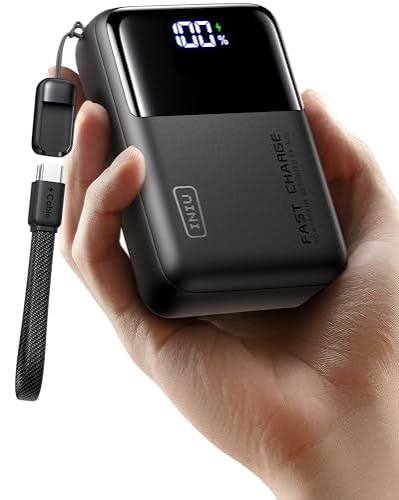
A power bank with a built-in cable reduces the number of separate accessories you need to carry and makes it easier to start charging quickly at the airport, in the car, or while walking around.
However, the built-in cable should not be the only reason you choose a model. Check:
-
The connector type.
-
Which devices it supports.
-
Its supported charging wattage.
-
Whether you can use a separate cable when necessary.
Built-in cables can make travel more convenient, but charging performance and device compatibility should still come first.
Is a Magnetic Power Bank Good for Travelling With an iPhone?
For compatible iPhone users, a magnetic power bank can be especially convenient while travelling because it attaches to the back of the phone and allows you to continue using the device without a cable running between the phone and battery.
That can be useful when walking around with navigation open or waiting at the airport.
Convenience is not the only consideration, though. Wired USB-C charging may be preferable when charging speed or energy efficiency is the priority, depending on the phone and power bank.
There is therefore no universal answer to magnetic versus wired charging:
Magnetic: Convenient, portable, and requires fewer cables.
USB-C: A practical choice when speed and efficiency are the priority.
iPhone users can also read Cart's guide to choosing the best power bank for iPhone to compare capacity, magnetic charging, and travel-friendly options.
How to Choose the Best Power Bank for Different Types of Travel
Not every trip has the same power requirements. A better approach is to choose according to your travel style.
Short Trips and Weekend Breaks
Prioritise portability over maximum capacity.
If your main goal is to keep your phone running throughout the day, a 10,000mAh power bank can provide a strong balance between available energy and compact size.
Long International Trips
A larger energy reserve becomes more valuable when you have long flights, airport waits, and extended periods of travelling between destinations.
A 20,000mAh model may be practical, provided you verify its Wh rating and your airline's policy.
USB-C PD, fast charging, and multiple ports can also improve the experience if you travel with several devices.
Business Travel
If your bag contains a phone, tablet, and laptop, focus on Power Delivery, wattage, and power distribution rather than capacity alone.
Depending on your devices, you may need 65W, 100W, or another output level. Check each device's requirements before deciding.
Backpacking and Frequent Movement
Every extra gram becomes more noticeable after hours of carrying your bag.
Look for a durable design, practical size, relatively low weight, and efficient charging. A built-in cable can also reduce the number of accessories you need to pack.
Family Travel
Multiple phones, earbuds, tablets, and other devices make capacity and port count increasingly important.
A multi-port model may be useful, but check how power is distributed when several outputs are used simultaneously.
Travel Power Bank Options to Consider From Cart
Instead of treating one product as the best power bank for travel for everyone, it makes more sense to choose according to the type of traveller and devices involved.
Cart offers different categories, including compact power banks, higher-capacity options, magnetic models, USB-C PD devices, and products with built-in cables.
Compact Option: Zendure SuperMini 10000mAh
For travellers who want something compact for short trips and everyday use, the Zendure SuperMini 10000mAh is listed in Cart's content with a 10,000mAh capacity and 20W USB-C PD support.
Its main advantage for this type of traveller is not carrying the largest possible battery. It is finding a practical balance between useful capacity and portability.
Higher-Capacity Option: Joyroom 20000mAh 22.5W
If greater capacity is your priority, the Joyroom 20000mAh 22.5W appears among Cart's options with 22.5W fast charging, a digital display, and multiple ports.
The larger capacity makes this category more practical for longer trips or travellers who use their phones heavily, although you should always check the exact battery specifications and airline policy before flying.
Option for Samsung Users: Samsung 20000mAh 45W Battery Pack
For Galaxy users looking for higher capacity combined with stronger charging output, the Samsung 20,000mAh 45W Battery Pack appears in Cart's Samsung power bank guide with support for up to 45W charging and multiple-device use.
This is a good example of why choosing according to the devices you actually own can be more useful than choosing based on capacity alone.
Magnetic Option for iPhone Users
If your priority is reducing cables and making your phone easier to use while moving around, consider browsing MagSafe power banks at Cart rather than focusing only on the largest possible battery capacity.
Magnetic models can be particularly convenient for travel and everyday movement, while wired USB-C remains worth considering when speed and efficiency matter more.
Still deciding between capacity, size, and charging speed? Browse power banks at Cart and compare your options according to how you actually travel rather than simply choosing the biggest battery.
Quick Comparison of the Best Types of Power Banks for Travel
|
Type |
Main Advantage |
Best For |
What to Check |
|
10,000mAh Compact |
Lightweight and portable |
Short trips |
Lower energy reserve |
|
20,000mAh |
More stored energy |
Long trips |
Size and weight |
|
USB-C PD |
Faster charging for compatible devices |
USB-C users |
Port wattage |
|
Magnetic |
Cable-free use |
Compatible iPhones |
Charging speed and efficiency |
|
Built-in Cable |
Fewer accessories |
Light, organised travel |
Cable output |
|
High-Wattage PD |
Can support larger devices |
Business travel and laptops |
Device compatibility and battery rules |
Common Mistakes When Buying a Power Bank for Travel
One of the biggest mistakes is assuming that more capacity automatically means a better travel power bank. You may end up paying more and carrying additional weight without ever using the extra energy, or choose a battery that requires more attention to airline restrictions.
Another mistake is relying only on mAh when flying. Always check the Wh rating.
Charging output is also easy to overlook. A 20,000mAh power bank with relatively low output may give you plenty of stored energy without providing the charging speed you need during a short airport stop.
Don't forget the cable either. Even if your phone and power bank support fast charging, an unsuitable cable can prevent you from achieving the expected performance.
You should also never place a power bank in checked baggage, and you should not travel with a swollen or damaged battery.
Finally, do not assume that every airline applies identical rules. Check the airline you are travelling with, particularly when carrying a high-capacity power bank.
Power Bank Checklist Before You Travel
Before heading to the airport, make a quick check. Make sure the Wh rating is visible and readable, the power bank is in your cabin baggage rather than checked luggage, the battery casing is intact and shows no signs of swelling or damage, and you have reviewed your airline's current battery policy.
Also check that you have the right charging cable and that the power bank itself is sufficiently charged before the trip begins.
These simple checks are far better than reaching the boarding gate and discovering that your power bank does not suit your needs or that its battery specifications are unclear.
FAQs About the Best Power Bank for Travel
What Is the Best Power Bank Capacity for Travel?
There is no single capacity that works for everyone. A 10,000mAh power bank is practical for travellers who prioritise size and weight, while 20,000mAh provides a larger energy reserve for longer trips and heavier use. When flying, check the Wh rating as well as mAh.
Is a 10,000mAh Power Bank Good for Travel?
Yes. It can be an excellent option for short trips and keeping a phone charged throughout the day, particularly if you want something compact and easy to carry.
Is a 20,000mAh Power Bank Good for Travel?
Yes. It can be particularly useful for long trips or charging several devices. However, it is generally larger and heavier than a 10,000mAh model. For air travel, also check its Wh rating and your airline's policy.
Is a 20,000mAh Power Bank Allowed on a Plane?
Do not rely on mAh alone. Check the Wh rating printed on the device and your airline's rules. Power banks are treated as spare batteries and should be carried in the cabin according to the applicable requirements.
Is a 30,000mAh Power Bank Allowed on a Plane?
You cannot determine this from the 30,000mAh figure alone. You need to know the voltage and actual Wh rating. If the battery exceeds 100Wh, additional requirements may apply, so check the product specifications and airline policy before travelling.
Should a Power Bank Go in Carry-On or Checked Baggage?
Keep your power bank in cabin baggage, subject to applicable requirements, rather than checked baggage. If your carry-on is gate-checked, remove the power bank before the bag is placed in the aircraft hold.
Can You Use a Power Bank on a Plane?
Rules regarding the use and charging of power banks during a flight can vary between airlines. Follow your airline's policy and cabin crew instructions rather than assuming that onboard use is permitted on every flight.
What Is the Difference Between mAh and Wh?
mAh measures battery capacity in terms of electric charge, while Wh measures energy while accounting for voltage. For air-travel battery rules, Wh is the more important figure.
Is Power Delivery Important in a Travel Power Bank?
It can be particularly useful if you carry compatible USB-C devices and want faster charging or need to power devices with higher energy requirements. You should still check the actual wattage available from the relevant port.
Is a Magnetic Power Bank Good for Travel?
Yes, especially if convenience and reducing cables are priorities. However, it is not necessarily the best choice for everyone. Wired charging may be more suitable when charging speed and efficiency matter most.
Can You Charge a Laptop With a Power Bank While Travelling?
Yes, provided that the laptop, power bank, and cable are compatible and the power bank can supply the required wattage. The mAh capacity alone does not determine whether a power bank can charge a laptop.
Conclusion: What Is the Best Power Bank for Travel?
The best power bank for travel is the one that provides the energy you actually need without forcing you to carry unnecessary capacity and weight.
For short trips and moderate use, 10,000mAh can offer an excellent balance between portable size and useful backup power. For longer trips or multiple devices, 20,000mAh may provide greater flexibility. If you travel for work with a laptop or other high-power devices, USB-C PD and output wattage become much more important specifications.
For air travel, don't let mAh be the only number you check. Look at the Wh rating, keep the power bank in your cabin baggage, and review your airline's current policy before travelling.
Ultimately, the smarter choice is not necessarily the biggest battery. It is the power bank that matches your trip, your devices, and the way you use them.
Prepare your power before the journey begins. Browse power banks at Cart and compare capacities, charging technologies, and designs to find the right power bank for your next trip.