A new iPhone is something most people want to protect from day one, and the screen is usually the first concern. But start shopping for the best iPhone screen protector, and what seemed like a simple purchase quickly becomes confusing.
Tempered glass or film? Clear or privacy? Is anti-glare worth it? Does 9H actually matter? And will the protector still fit properly once you put a case on your phone?
There isn't one screen protector that's right for every iPhone user. A better choice is one that balances:
Protection + Display Clarity + Touch Response + Case Compatibility + Daily Use + Price
Someone who spends hours watching videos or editing photos, for example, may care more about clarity. Someone who regularly uses their phone on public transport may be willing to trade a little brightness for better privacy.
This guide breaks down the main types of iPhone screen protectors, what actually matters when comparing them, and some of the options available on Cart.
Looking for the right protection for your iPhone?
Browse iPhone screen protectors available on Cart and compare your options by iPhone model and the type of protection you need.
Does Your iPhone Really Need a Screen Protector?
Modern iPhones are built to handle everyday use, but that doesn't make their displays immune to scratches or damage.
A screen protector adds a replaceable layer over the original display. Depending on its material and design, it can help protect the surface against scratches and some of the wear that comes with daily use.
What it cannot do is make your iPhone screen unbreakable.
If your phone is dropped, the outcome depends on several factors: how far it falls, the angle of impact, the surface it lands on, the case you're using, and the screen protector itself.
In other words, think of a screen protector as an extra layer of protection rather than a guarantee against damage.
When Is a Screen Protector Particularly Useful?
A screen protector is worth considering if you regularly carry your phone outside the house, sometimes keep it in a bag or pocket with other objects, tend to drop your phone occasionally, or simply want to keep the display in good condition for as long as possible.
It's also useful if you travel frequently or plan to sell or trade in your iPhone later. A screen with fewer scratches is easier to keep looking its best over time.
What Types of iPhone Screen Protectors Are Available?
One mistake people make when looking for the best screen protector for an iPhone is treating every protector as essentially the same product.
They're not. Different materials and designs solve different problems.
Tempered Glass Screen Protectors
Tempered glass is probably the type most iPhone users are familiar with.
It adds a layer of glass over the original display and generally feels closer to the phone's actual screen than many plastic films do. For everyday users, it can offer a useful balance of protection, clarity, and a familiar touch experience.
That doesn't mean every tempered glass protector performs equally well, though. Glass quality, adhesive, edge design, coating, thickness, and fit can all vary.
So don't choose a product simply because the packaging says "Tempered Glass."
Privacy Screen Protectors
A privacy screen protector makes the display more difficult to see from certain side angles.
This can be useful if you regularly use your iPhone on public transport, at university, in shared offices, or while travelling.
The trade-off is that privacy filters can affect viewing angles and perceived brightness to varying degrees. That's part of how the privacy effect works, so it's worth considering whether privacy matters enough to you to accept that compromise.
Cart currently carries privacy options for iPhones from brands including UNIQ, Baseus, WIWU, and Joyroom.
Want more privacy when using your phone in public?
Explore privacy screen protectors on Cart and look for an option made for your exact iPhone model.
Matte and Anti-Glare Screen Protectors
If reflections are what bother you most, a matte or anti-glare screen protector may make more sense.
These protectors are designed to reduce glare from surrounding light, which can make the phone more comfortable to use in bright environments.
There is a compromise here as well. A matte surface can change the way images look compared with highly transparent clear glass, particularly when it comes to sharpness.
If you edit photos or videos on your phone and accurate display quality is a priority, keep that in mind before choosing matte protection.
Film Screen Protectors
Film protectors are generally thinner and lighter than tempered glass. They're mainly useful for adding a protective layer against everyday scratches and surface wear.
They can be a good option if you want something very thin and don't want the feel of an additional glass layer.
However, you shouldn't assume a film protector will provide the same impact protection as tempered glass. Performance depends heavily on the material and construction of the individual product.
Full-Coverage Screen Protectors
Full-coverage protectors are designed to cover more of the front of the iPhone.
That sounds automatically better, but there's one important question to ask:
Will it work with your case?
If a protector extends too close to the edges, a tightly fitted or raised-edge case may push against it. That can eventually cause the protector to lift.
iPhone Screen Protector Types Compared
|
Type |
Scratch Protection |
Privacy |
Display Clarity |
Best For |
|
Tempered Glass |
Good to high, depending on product |
No |
Usually high |
Everyday use |
|
Privacy Glass |
Varies |
Yes |
May be slightly reduced |
Public spaces |
|
Matte / Anti-Glare |
Varies |
No |
May be slightly affected |
Reducing reflections |
|
Film |
Good surface protection, depending on material |
No |
Usually high |
Scratch protection |
|
Full Coverage |
Depends on material |
Depends on type |
Depends on product |
Wider screen coverage |
These are general differences. The actual experience still depends on the quality and design of the individual screen protector.
How to Choose the Best Screen Protector for Your iPhone
Once you know the main types, the decision becomes much easier. Instead of looking for the protector with the longest feature list, focus on the features that matter for your phone and the way you use it.
1. Start With Your Exact iPhone Model
Don't buy a protector simply because it says "for iPhone."
You need the exact model.
An iPhone 15, iPhone 15 Pro, and iPhone 15 Pro Max aren't interchangeable. The same applies to other iPhone generations.
Dimensions, edges, cutouts, and other design details can vary between models, so always check compatibility before ordering.
2. Decide How Much Protection You Actually Need
Think about where and how you use your phone.
Someone whose iPhone spends most of its time at home or in an office may have different priorities from someone who travels every week or uses the phone outdoors for hours every day.
Instead of asking, "What's the strongest screen protector available?" ask:
"What level of protection makes sense for the way I use my phone?"
3. Don't Sacrifice Display Quality Without a Reason
Your screen is the part of the iPhone you look at every time you use it. A protector shouldn't make you forget how good that display looked before you installed it.
Pay attention to:
-
Text clarity.
-
Image and video quality.
-
Colour reproduction.
-
Transparency.
This matters even more if you use your iPhone for photography, content creation, video editing, or a lot of media consumption.
4. Check Touch Responsiveness
A screen protector sits directly between your fingers and the display, so touch performance matters.
Typing, scrolling, gestures, gaming, and navigating between apps should still feel natural.
A good protector should add protection without making the phone feel frustrating to use.
5. Look for a Good Oleophobic Coating
Fingerprints and skin oils quickly build up on a screen that's touched hundreds of times a day.
An oleophobic coating helps reduce how easily oils stick to the surface and can make the protector easier to wipe clean.
It's a useful feature, but don't judge a product on the word "oleophobic" alone. The quality and durability of the coating can differ significantly between products.
6. Make Sure It's Case-Friendly
If you use an iPhone case, don't choose your screen protector in isolation.
Look for a case-friendly screen protector, or at least make sure there's enough clearance around the edges for your case.
You can also browse iPhone cases available on Cart and think of the case and protector as two parts of the same protection setup.
7. Consider Edge Coverage
Some protectors focus mainly on the usable display area, while others extend closer to the edges.
Edge-to-edge coverage isn't automatically the better option. If your case has pronounced raised edges, a slightly smaller case-friendly protector may actually work better.
8. Check How Easy It Is to Install
A high-quality screen protector can still be frustrating if you install it badly.
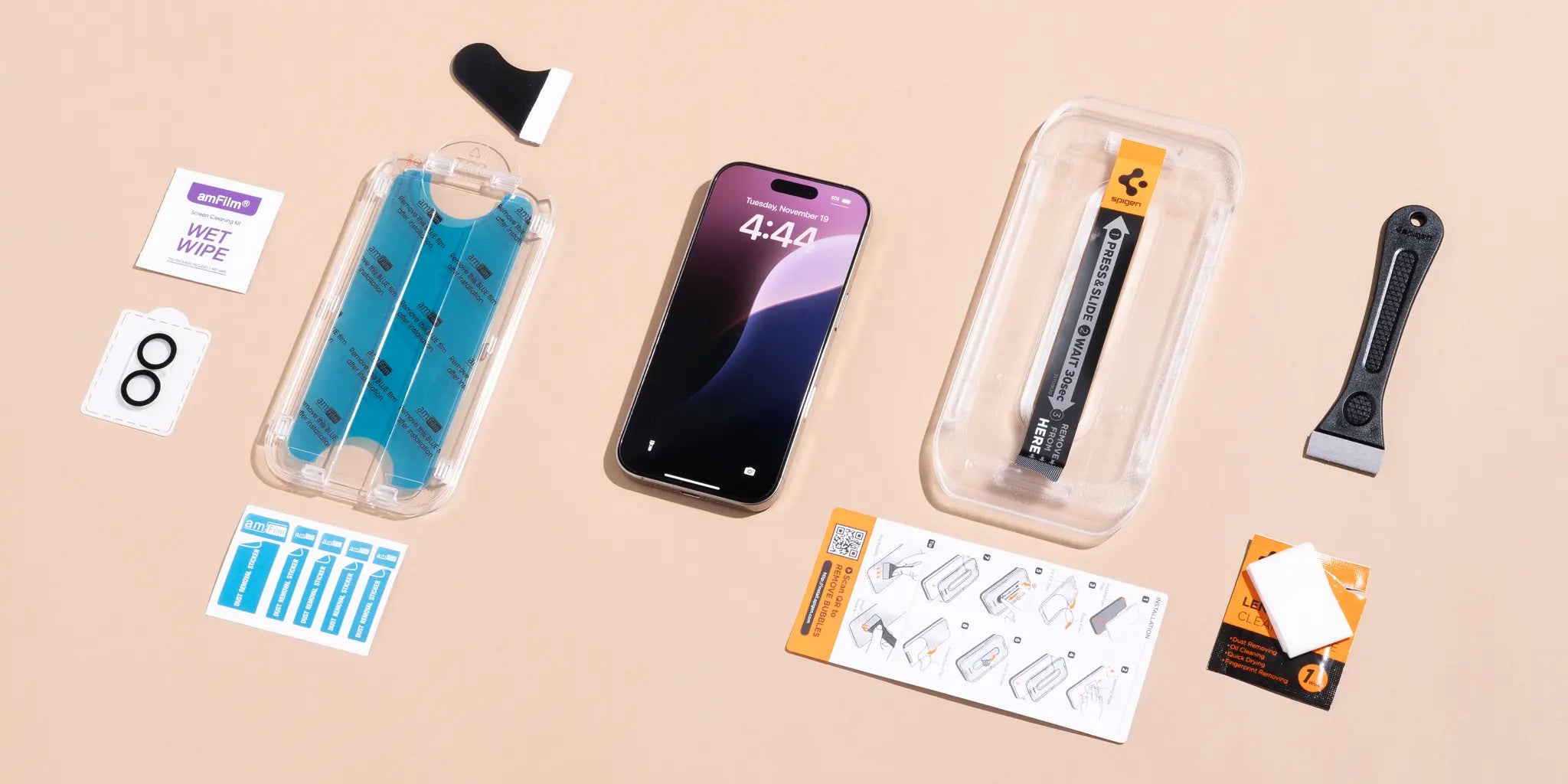
Features such as an alignment frame, installation tray, dust-removal stickers, and cleaning kit can make a noticeable difference, particularly if you're fitting the protector yourself.
Don't compare screen protectors on price alone.
Browse the iPhone screen protector collection on Cart and compare compatibility, protection type, privacy features, and installation before deciding.
What Does 9H Mean on a Screen Protector?
You'll see 9H Hardness printed on many tempered glass protectors. It's also one of the most misunderstood specifications in the category.
9H is commonly used to describe the protector's surface scratch resistance according to a particular hardness test. It does not mean the protector cannot crack, and it isn't a guarantee that your screen will survive every drop.
Put simply:
9H does not mean drop-proof.
That's why it shouldn't be the only specification you consider.
A more useful comparison looks at the material, fit, adhesive quality, edge design, display clarity, case compatibility, and installation method together.
Does Thicker Glass Mean Better Protection?
Not necessarily.
It's easy to assume that a thicker screen protector must be safer, but thickness is only one part of its construction.
Other factors include the type and quality of glass, adhesive, edge design, manufacturing quality, fit, and the way the protector is constructed to handle impact.
Extra thickness can also change how a protector feels or how well it fits with certain cases.
So when two products have different thicknesses, don't use that number alone to decide which one is better.
Privacy vs. Clear: Which iPhone Screen Protector Should You Choose?
This decision comes down to what you value more.
Choose a Clear Screen Protector If:
A clear protector makes sense if display quality is one of your main priorities. It's particularly suitable if you watch a lot of videos, view photos frequently, or simply want the screen to look as close as possible to the original display.
If people seeing your screen from the side isn't a concern, there's little reason to compromise viewing angles for a privacy feature you don't need.
Choose a Privacy Screen Protector If:
Privacy glass makes more sense if you regularly use your phone on public transport, at university, in a shared workplace, while travelling, or anywhere else where people are often sitting beside you.
|
Factor |
Clear Glass |
Privacy Glass |
|
Display clarity |
Usually higher |
May be reduced depending on product |
|
Side-angle privacy |
No |
Yes |
|
Sharing content with others |
Easier |
Less convenient from an angle |
|
Public use |
Good |
Better for privacy |
Neither option is universally better.
If privacy isn't a real problem in your day-to-day life, clear glass is usually the more straightforward choice. If you're constantly using your phone around other people, the privacy trade-off may be worthwhile.
Tempered Glass vs. Film: Which Is Better for an iPhone?
Tempered glass and protective film don't solve the problem in quite the same way.
Tempered glass provides a glass layer and typically feels more like the original display. It's a popular choice for users who want protection against scratches along with an additional layer that may help with some everyday impacts.
Film, on the other hand, is usually thinner and focuses more on surface protection from scratches and wear.
A simple way to choose is:
Want a glass-like feel and more substantial everyday protection? → Tempered Glass
Want a very thin layer mainly for scratch protection? → Film
The quality of the individual product still matters more than the category name alone.
Best iPhone Screen Protector by Use Case
There isn't one "best" protector for every user. Your routine should influence what you buy.
Best for Everyday Use
For many users, clear tempered glass offers the most practical balance between daily protection and display clarity.
Look for good transparency, case compatibility, and a smooth surface coating.
Best for Privacy
If you use your iPhone in public frequently, look for privacy glass made specifically for your model.
Just remember that brightness and viewing angles may feel different compared with clear glass.
Best for Travel
Travel puts different demands on a phone. You're using it in airports, planes, stations, taxis, and other public spaces, so both protection and privacy may matter more.
Privacy tempered glass can make sense here, although someone who values maximum display quality may still prefer clear glass.
Best for Gaming
For gaming, prioritise:
Touch Responsiveness + Smooth Surface + Clarity
A feature-heavy protector isn't useful if the surface makes swipes or fast movements less comfortable.
Best for Content Creators
If you review photos and videos on your iPhone, display clarity and colour reproduction should sit near the top of your list.
A high-transparency clear protector may therefore be a better fit than privacy or matte glass.
Best for Heavy Outdoor Use
If your iPhone spends a lot of time outside the house, look for a combination of scratch resistance, reliable adhesion, suitable coverage, and case compatibility.
Pairing the protector with a good case is more useful than relying on the screen protector alone.
Best iPhone Screen Protectors Available on Cart
Cart's iPhone screen protector collection includes a wide selection of options from brands such as Joyroom, Baseus, UNIQ, Blueo, and WIWU, covering different iPhone generations.
Rather than choosing by brand name alone, it makes more sense to compare products based on the problem you want them to solve.
Joyroom Tempered Glass Screen Protector for iPhone 17 – Best for Everyday Use
If you have an iPhone 17 and want straightforward clear tempered glass, the Joyroom HD + Dustproof Tempered Glass Screen Protector is one option available on Cart.
According to the product information, it uses 0.33 mm aluminosilicate glass, offers over 90% transparency, and has a dust-resistant and anti-static design. The listing also highlights bubble-free installation and compatibility with most iPhone 17 cases.
Best for you if: You own an iPhone 17 and want a clear tempered glass protector that focuses on everyday protection without giving up display clarity.
Looking for clear protection for your iPhone 17?
View the Joyroom Tempered Glass Screen Protector for iPhone 17 on Cart.
Blueo AR Anti-Reflective Tempered Glass – Best for Reducing Reflections
Cart also carries Blueo AR Anti-Reflective Tempered Glass for models including the iPhone 17 and iPhone 17 Pro Max.
This type of protector is aimed at users who want the familiar feel of tempered glass while reducing distracting reflections.
Best for you if: Screen glare regularly bothers you during everyday use.
Not sure whether to choose anti-reflective, clear, or privacy glass?
Browse iPhone screen protectors on Cart and compare the available options for your model.
Baseus Sapphire Privacy Tempered Glass – Best for Privacy
If privacy is your priority, Cart's range includes Baseus Sapphire Privacy Tempered Glass for models such as the iPhone 15 Pro Max, alongside other privacy protectors.
It's a more relevant option for people who regularly use their phones on public transport, in offices, or in other shared spaces and want to make the display less visible from the side.
Best for you if: Privacy is a regular concern when you use your iPhone.
Want to make your screen harder to view from the side?
Browse privacy screen protectors available on Cart and choose one compatible with your iPhone.
UNIQ OPTIX – Clear and Privacy Options for Different iPhones
UNIQ OPTIX is another range available on Cart, with both clear and privacy options for different iPhone models, including models within the iPhone 13 and iPhone 14 families.
That gives you the flexibility to choose the viewing experience you want first—clear or privacy—and then find the version designed for your phone.
Best for you if: You want to compare clear and privacy protection across several iPhone models.
Joyroom Privacy Screen Protector – Practical Privacy Protection
Cart also lists Joyroom privacy protectors for models including the iPhone 13, iPhone 13 Pro, and iPhone 13 Pro Max.
Best for you if: You own one of the compatible models and want to add side-view privacy to your everyday screen protection.
Still not sure which protector to choose?
Start with the iPhone screen protector collection on Cart. Select your exact iPhone model first, then compare clear, privacy, and anti-reflective options.
Comparing iPhone Screen Protectors Available on Cart
|
Option |
Type |
Main Benefit |
Best For |
|
Joyroom iPhone 17 HD + Dustproof |
Tempered Glass |
Everyday protection + clarity |
iPhone 17 users |
|
Blueo AR |
Anti-Reflective Tempered Glass |
Reduced reflections |
Bright environments |
|
Baseus Sapphire Privacy |
Privacy Tempered Glass |
Side-view privacy |
Commuting and public spaces |
|
UNIQ OPTIX Clear |
Clear Glass |
Display clarity |
Everyday use |
|
UNIQ OPTIX Privacy |
Privacy Glass |
Privacy |
Work and commuting |
|
Joyroom Privacy |
Privacy Glass |
Protection + privacy |
Users who prioritise privacy |
Models, prices, and availability can change, so check the relevant product page before ordering.
Do You Need an iPhone Camera Lens Protector Too?
A screen protector covers the front of your iPhone, but it doesn't protect the rear camera lenses.
If you're concerned about the camera area, you generally have two options.
A case with a raised camera lip helps keep the lenses from making direct contact with flat surfaces.
A camera lens protector adds a separate protective layer over the camera area.
If you decide to use a lens protector, choose one made specifically for your iPhone model. Anything placed over a camera lens has the potential to affect image quality if the material, fit, or installation isn't right.
Cart also offers iPhone protection bundles for selected models that combine products such as a screen protector, clear TPU case, and camera lens protector.
Can You Use Any iPhone Case With a Screen Protector?
Not always.
If your case has high edges and your screen protector extends too close to the sides of the display, the case may push against the protector.
Over time, that can cause:
-
Lifted edges.
-
Air bubbles.
-
Dust getting underneath.
-
Movement or poor adhesion.
Look for case-friendly protection or check the dimensions before buying.
It's usually better to think of your case and screen protector as one protection system, rather than choosing each product without considering the other.
When Should You Replace an iPhone Screen Protector?
There isn't a fixed replacement schedule that works for everyone.
Instead of automatically changing your protector every few months, look at its condition.
It's probably time for a replacement if you notice significant cracks, chipped or lifting edges, heavy scratches that affect visibility, persistent bubbles caused by deteriorating adhesive, or surface damage that makes the screen uncomfortable to use.
If the phone has suffered a hard drop and the protector has cracked, remove it carefully and inspect the original display for damage.
How to Install an iPhone Screen Protector Without Bubbles
Even the best iPhone screen protector won't look good if dust gets trapped underneath it.
1. Find a Clean Place to Work
Dust is one of the main causes of small bubbles and visible spots beneath a protector.
2. Clean the Display Thoroughly
Use the cleaning materials supplied with the protector and remove fingerprints, oil, and dust from the screen.
3. Remove Any Remaining Dust
If your installation kit includes dust-removal stickers, use them before applying the protector.
4. Use the Alignment Frame
If an alignment frame or installation tray is included, use it. It can make positioning the protector correctly much easier.
5. Avoid Touching the Adhesive
Fingerprints or dust on the adhesive side can be difficult to remove once they're there.
6. Apply the Protector Gradually
Follow the manufacturer's installation instructions, then gently push any remaining air bubbles toward the nearest edge.
What If You Still Have a Bubble?
If it's simply trapped air, you may be able to push it toward the edge.
If there's a piece of dust underneath, however, you may need to carefully lift part of the protector and remove the particle according to the product's installation instructions.
Common Mistakes When Buying an iPhone Screen Protector
Even a good product can be a poor choice if it doesn't suit your phone or your needs. Some of the most common mistakes include buying a protector for the wrong iPhone model, choosing entirely on price, assuming 9H means the glass cannot break, or buying privacy glass without actually needing privacy.
Case compatibility is another easy detail to overlook. A great case and a great screen protector can still work badly together if their edges overlap.
Installation matters too. Applying a protector in a dusty room, touching the adhesive, or rushing the alignment can leave you with bubbles and trapped particles that have nothing to do with the quality of the protector itself.
Finally, don't expect complete protection. A screen protector is one part of protecting your iPhone, not a guarantee against every possible type of damage.
Is a Cheap Screen Protector Good Enough?
Sometimes. Price alone doesn't tell you whether a screen protector will be right for you.
Instead, compare:
Fit + Material + Clarity + Coating + Installation + Case Compatibility + Features + Price
There's no reason to pay extra for privacy glass if you never need privacy. On the other hand, paying a little more for a protector with a well-designed installation tray may be worthwhile if you're installing it yourself and want to avoid wasting the first one.
The better question isn't, "Which protector has the most features?"
It's:
"Which features will I actually use?"
How to Choose an iPhone Screen Protector in 60 Seconds
Before you buy, run through this quick checklist:
-
Confirm your exact iPhone model.
-
Choose tempered glass or film based on the protection you want.
-
Decide whether privacy is genuinely useful to you.
-
Check display clarity.
-
Consider touch responsiveness.
-
Look for a quality surface coating if fingerprints bother you.
-
Confirm case compatibility.
-
Check the installation method and included tools.
-
Don't rely on 9H alone.
-
Compare the price with the features you'll actually use.
Once you've answered those questions, choosing between dozens of screen protectors becomes much easier.
Ready to choose?
Browse iPhone screen protectors on Cart, select your exact iPhone model, and compare clear, privacy, and anti-reflective options.
Frequently Asked Questions About iPhone Screen Protectors
What Is the Best Screen Protector for an iPhone?
There isn't one screen protector that's best for everyone. Clear tempered glass is a practical all-round option for many users. Privacy glass makes more sense if side-view privacy matters, while anti-glare or anti-reflective protection can be useful if reflections are your main concern.
Does an iPhone Really Need a Screen Protector?
It's not required to use the phone, but a screen protector provides a replaceable layer that can help protect the surface from scratches and some everyday wear.
Is Tempered Glass Better Than Film?
It depends on what you need. Tempered glass typically provides a more substantial glass layer and a feel closer to the original screen. Film is generally thinner and more focused on surface scratch protection.
What Does 9H Mean on a Screen Protector?
9H generally refers to a surface hardness rating used in scratch-resistance testing. It does not mean the protector is unbreakable or that it can prevent damage from every drop.
Can a Screen Protector Stop an iPhone Screen From Cracking?
No screen protector can guarantee that. It adds an extra protective layer, but the result of a drop depends on the impact, surface, case, protector, and other factors.
Does a Privacy Screen Protector Make the iPhone Screen Darker?
It can reduce perceived brightness or visibility from certain angles, depending on the design and quality of the protector. That's part of how side-view privacy is achieved.
Can a Screen Protector Affect Touch Sensitivity?
A well-made, correctly installed protector should maintain good touch performance, but the experience can vary with material, thickness, construction, and product quality.
Can I Use a Screen Protector With a MagSafe Case?
Yes. MagSafe primarily concerns the magnetic and charging system on the back of the iPhone. What you need to check is whether the edges of the screen protector fit properly with the case itself.
Does a Screen Protector Cover the Dynamic Island?
It depends on the protector's design and the iPhone model. Check the product images and specifications to see how the protector covers or cuts around the front sensors and camera area.
Do I Need to Protect the iPhone Camera Lenses Too?
That's a personal choice. A case with raised edges around the camera can provide some physical separation from surfaces, while a compatible lens protector adds another layer over the camera area.
How Do I Know Whether a Screen Protector Fits My iPhone?
Check the exact iPhone model listed on the product page. Don't rely on screen size alone.
When Should I Replace My iPhone Screen Protector?
Replace it when it's badly cracked, lifting at the edges, heavily scratched, losing adhesion, or otherwise interfering with normal use.
How Do I Remove Bubbles From an iPhone Screen Protector?
Air bubbles can often be pushed gently toward the nearest edge. If dust is trapped underneath, part of the protector may need to be lifted carefully so the particle can be removed.
Is an Expensive Screen Protector Always Better?
No. Price is only one factor. Fit, material, display clarity, coating, installation, case compatibility, and the features you actually need are more useful criteria.
Conclusion: Which iPhone Screen Protector Is Right for You?
Choosing the best iPhone screen protector isn't really about finding the most expensive product or the one with the longest list of specifications. It starts with understanding how you use your phone.
For straightforward everyday protection without giving up display clarity, clear tempered glass is a sensible place to start.
If you regularly use your iPhone on public transport, in shared offices, or in other public spaces, a privacy screen protector may be worth the trade-off in viewing angles.
And if reflections are what frustrate you most, an anti-glare or anti-reflective protector may be the better fit.
Before buying, work through this simple order:
iPhone Model → Protection → Clarity → Privacy → Case Compatibility → Installation → Price
That approach helps you avoid paying for features you don't need and makes it much easier to find a screen protector that suits both your iPhone and the way you actually use it.
Ready to protect your iPhone screen?
Explore the iPhone screen protector collection on Cart and compare the clear, privacy, and anti-reflective options available for your model.