When your phone battery drops to 15% and you still have hours left in your day, carrying a power bank becomes more than just a convenience. But buying one introduces another question: what capacity should you choose?
A 5000mAh power bank is compact and easy to carry, but it may not provide enough backup power for a full day. A 20000mAh power bank gives you significantly more capacity, but it is usually larger and heavier.
That is where 10000mAh power banks offer a practical middle ground.
However, choosing the best 10000mAh power bank should not be based on capacity alone. You will find models offering 20W, 22.5W, 30W, or even higher output, alongside options with built-in cables, magnetic charging, multiple ports, and other features.
So, what do you actually need?
A useful way to think about it is:
Usable Capacity + Output Power + Charging Protocol + Portability + Features = The Right 10000mAh Power Bank
In other words, the best power bank is not necessarily the one with the highest wattage or the largest number of ports. It is the one that provides the capacity, charging speed, and convenience that match your everyday use.
Is a 10000mAh Power Bank Right for You?
For many users, yes.
A 10000mAh power bank is particularly practical if you need extra battery power for your phone during work, university, commuting, or travel without carrying a large power bank all day.
However, it is not the ideal capacity for every situation.
|
Your Use Case |
Is 10000mAh Suitable? |
What to Look For |
|
Everyday use |
Usually yes |
Compact size + fast charging |
|
Work or university |
Yes |
USB-C + fast charging |
|
iPhone |
Yes |
USB-C PD or compatible magnetic option |
|
Samsung Galaxy |
Yes |
PD/PPS depending on phone |
|
One-day travel |
Usually |
Practical size and weight |
|
Charging multiple phones |
Depends |
Multiple ports + suitable power distribution |
|
Tablet |
Depends on device |
Higher output |
|
Laptop |
Not always ideal |
High output + USB PD |
|
Several days without power |
May not be enough |
Consider 20000mAh |
The key advantage of 10000mAh is the balance between capacity and portability.
If your priority is storing as much energy as possible, larger capacities are available. But if you want a power bank you can comfortably carry every day, 10000mAh is one of the most practical categories to consider.
What Does 10000mAh Actually Mean?
One of the most common misconceptions when buying a power bank is assuming that the capacity printed on the device represents exactly how much energy will reach your phone.
The reality is slightly more complicated.
The 10000mAh figure refers to the nominal capacity of the internal battery cells under specific voltage conditions. When that stored energy is transferred to your phone, it passes through voltage conversion and power-management circuitry, which naturally results in some energy loss.
Therefore:
Nominal Capacity ≠ Usable Output Capacity
This does not mean there is anything wrong with the power bank. It is simply part of how battery storage and power conversion work.
It is also why you cannot accurately calculate the number of phone charges by simply dividing 10000 by your phone's battery capacity.
How Many Times Can a 10000mAh Power Bank Charge a Phone?
If your phone has a 5000mAh battery, the calculation may initially look simple:
10000 ÷ 5000 = 2 full charges
In practice, however, you should not expect two complete charges based on that calculation alone.
Some energy is lost during conversion and transfer, and the final result also depends on the phone, power bank, charging method, and conditions of use.
It is better to treat the number of charges as an estimate rather than a fixed figure.
|
Phone Battery Capacity |
Approximate Expectation |
|
3000mAh |
More than one full charge and potentially close to two depending on efficiency |
|
4000mAh |
Around one and a half charges in many situations |
|
5000mAh |
Around one full charge with additional power in many cases |
|
6000mAh |
Around one full charge, with the exact result depending on efficiency and use |
These are approximate figures.
Actual results depend on factors such as conversion efficiency, temperature, battery condition, whether you use the phone while it is charging, and whether charging is wired or wireless.
So if your main question is how many times a 10000mAh power bank will charge your phone, do not rely on nominal capacity alone.
Why Don't You Get the Full 10000mAh?
The energy stored inside a power bank is not transferred to your phone with 100% efficiency.
The process can be simplified as:
Battery Cells → Voltage Conversion → Power Management → Cable/Wireless Transfer → Phone Battery
Natural energy losses occur throughout this process.
Wireless charging, for example, can have different efficiency characteristics from wired charging, while heat and using your phone during charging can also affect the final amount of energy delivered.
For this reason, two power banks with the same 10000mAh rating will not necessarily provide an identical real-world experience.
10000mAh vs 20000mAh Power Bank: Which Is Better?
It depends on your priorities.
If you want a power bank you can use every day and easily carry in your bag or pocket, 10000mAh is usually more practical.
If your priority is getting as much backup energy as possible between recharges, a 20000mAh model may make more sense.
|
10000mAh |
20000mAh |
|
Usually lighter and easier to carry |
Usually larger and heavier |
|
Ideal for everyday use |
Better for heavier use |
|
Practical for phones |
Better for multiple devices |
|
Good for a day away from an outlet |
Better for longer periods |
|
Strong balance between size and capacity |
Prioritizes capacity |
|
Easier for commuting |
Takes up more bag space |
The difference can be summarized as:
10000mAh = Portability First
20000mAh = Capacity First
If you mainly charge one phone during the day, you may not need to double the capacity and carry the additional size and weight.
If you regularly charge several devices or spend long periods away from a power outlet, the larger capacity becomes more useful.
What Charging Speed Should a 10000mAh Power Bank Have?
Once you have chosen the capacity, the next question is: how many watts do you need?
Capacity and charging power are two completely different things.
mAh = How much energy the power bank can store
while:
Watts = The charging power that can be delivered within a compatible setup
That means two power banks can both have a 10000mAh capacity while one delivers 20W and the other delivers 30W.
18W or 20W Power Bank
This can be enough for many smartphones that do not require particularly high charging power.
If your phone is designed to take advantage of around 20W, you do not need a 65W power bank simply because the number is higher.
22.5W Power Bank
This output is common in several modern power banks and can provide fast charging for compatible devices depending on the charging protocol.
Again, however, do not look at 22.5W alone. Check your phone and the protocols supported by the power bank.
30W Power Bank
A 30W model gives you more flexibility, especially if you have devices that can take advantage of higher charging power or want to use the same power bank with both a phone and a tablet.
But remember:
30W Power Bank + 20W Phone ≠ 30W Phone Charging
Your phone will not automatically charge faster simply because the power bank can supply more power.
Do You Need 45W or More?
Higher output can be useful for certain smartphones, tablets, and other devices, but it should not automatically become your main buying criterion when choosing a 10000mAh power bank.
Always start with the device you intend to charge.
Read also: How Many Watts Does Your Phone Need for Fast Charging?
Is a 30W Power Bank Better Than a 20W Power Bank?
Not necessarily.
If your phone can only take advantage of 20W, moving to a 30W power bank does not automatically result in significantly faster charging.
If your phone or tablet supports higher charging power and the required charging protocol, however, the additional output can become useful.
Actual performance depends on:
Phone + Power Bank Output + Charging Protocol + Cable = Actual Charging Speed
That matters far more than comparing 20W and 30W in isolation.
Why Do PD, PPS, and Quick Charge Matter?
Because wattage alone does not guarantee that your phone will enter the fast-charging mode you expect.
You may have a 30W power bank, but your phone could require a particular protocol to reach a specific charging speed.
Technologies you may encounter include:
-
USB Power Delivery
-
PPS
-
Quick Charge
-
Manufacturer-specific charging technologies
This can be particularly important with certain Samsung devices, where compatible PD/PPS support may be required for specific Super Fast Charging modes.
Instead of looking only for:
10000mAh + 30W
check the charging protocols as well.
Read also: PD vs PPS vs Quick Charge: What's the Difference?
USB-C Input vs Output: An Important Difference
It is easy to focus on how quickly a power bank can charge your phone and forget another important question:
How quickly can you recharge the power bank itself?
You need to distinguish between:
Output Power: The power the power bank can deliver to your device.
Input Power: The power the power bank can accept when you recharge it.
A high output does not automatically mean the power bank itself can recharge at the same speed.
If you use your power bank every day, good input performance can make a meaningful difference. You do not want to leave it connected to a charger for an unnecessarily long time every time the battery runs low.
So check both:
Output + Input
not just output.
Power Bank With a Built-In Cable vs Without One
Built-in cables have become one of the most practical features in modern power banks, but they are not necessarily better for everyone.
When Is a Built-In Cable Better?
If you regularly use your power bank while commuting or traveling, having a built-in USB-C or Lightning cable means you do not have to remember to carry a separate cable.
It reduces the number of accessories in your bag and makes charging more convenient.
What Are the Drawbacks?
If the integrated cable becomes damaged, you may have less flexibility than with a traditional power bank that relies on replaceable cables.
You should also make sure the built-in connector suits both your current devices and the devices you may use in the future.
When Is a Separate Cable Better?
A removable cable gives you more freedom to choose:
-
USB-C or Lightning
-
Cable length
-
Power capability
-
Easy replacement
If those factors matter to you, a traditional design may offer greater flexibility.
Read also: Best Long Charging Cables
Wired vs Magnetic Power Bank: Which Should You Choose?
The choice is not only about charging speed. It is also about how you prefer to use your phone.
Wired Power Bank
A wired model is generally the more straightforward choice if your priorities are efficient charging and compatibility with different devices.
USB-C can work across a wide range of smartphones and tablets, and you can change the cable depending on the device.
Magnetic Power Bank
A magnetic power bank can offer a more convenient experience with compatible phones because it attaches to the back of the device, allowing you to use your phone without a cable hanging from it.
However, it is important to distinguish between:
Magnetic – MagSafe Compatible – Qi2 Certified
A product having magnets does not automatically mean it supports Qi2 or provides the highest wireless charging speed available to your phone.
Always check the actual specifications.
Wireless and magnetic charging can also differ from wired charging in efficiency, speed, and heat generation depending on the phone and power bank.
If convenience is your priority → Magnetic can be appealing.
If performance and versatility matter more → Wired is often more practical.
Is a 10000mAh Power Bank Good for iPhone?
Yes. This capacity is a practical choice for many iPhone users who want extra battery power during the day without carrying a large power bank.
However, the right configuration depends on your iPhone model.
For newer iPhones with USB-C, look for a USB-C power bank with appropriate USB Power Delivery support.
For older Lightning-equipped iPhones, make sure you have the appropriate port or cable.
If you prefer cable-free charging, a compatible magnetic power bank can also be considered, but check the wireless charging standard and actual supported output rather than relying on the word “Magnetic” alone.
Read also: Best Power Bank for iPhone
Is a 10000mAh Power Bank Good for Samsung Phones?
Yes, but the experience will not be identical across every Galaxy model.
Some Samsung phones have relatively large batteries, so do not assume that 10000mAh automatically means two full charges for a Galaxy phone with a 5000mAh battery.
If you also want to take advantage of Samsung Super Fast Charging, check:
Galaxy Model → Supported Wattage → PD/PPS → Power Bank Output → Cable
This is much more important than simply buying the highest-wattage power bank available.
Read also: Best Power Bank for Samsung Phones
Is a 10000mAh Power Bank Enough for a Tablet?
It can be, particularly as an additional source of power while studying, traveling, or working.
However, tablet batteries are generally larger than smartphone batteries, so you should expect fewer full charges.
Output power is also important because some tablets can take advantage of higher charging power than typical smartphones.
If a tablet will be one of your main devices, evaluate capacity and wattage together, not 10000mAh alone.
Can a 10000mAh Power Bank Charge a Laptop?
Here, it is important to distinguish between two concepts:
Capacity ≠ Output Power
You may find a 10000mAh power bank capable of providing enough USB-C output for certain compatible laptops, but the total stored energy remains relatively limited compared with the energy demands of a laptop.
A 10000mAh model may therefore work as an emergency top-up for some compatible devices, but it is not necessarily the best option if charging a laptop is your primary use case.
In that situation, you may need both a larger capacity and an output level that matches the laptop's requirements.
Is a 10000mAh Power Bank Suitable for Air Travel?
In terms of capacity, 10000mAh is a practical category for travel because it offers a useful balance between stored energy and portability.
For air travel, it is more useful to look at watt-hours (Wh) rather than mAh alone.
The energy can be estimated using:
Wh = Ah × Voltage
Assuming an internal cell voltage of approximately 3.7V:
10Ah × 3.7V ≈ 37Wh
That is below the commonly used 100Wh threshold for spare lithium batteries.
However, airline policies regarding the transport, storage, and use of power banks can vary and may change. Always check your airline's current rules before traveling rather than relying on one general rule.
Size and Weight: Why They Matter With 10000mAh Power Banks
One of the main reasons to choose 10000mAh instead of 20000mAh is portability.
If a 10000mAh power bank is so bulky and heavy that you regularly leave it at home, you are losing one of the biggest advantages of this capacity.
Consider:
-
Weight
-
Thickness
-
Overall dimensions
-
Whether it fits comfortably in your everyday bag
-
Whether you want to carry it in a pocket
-
Whether you will use it while walking
-
Whether a built-in cable reduces the accessories you need to carry
With magnetic models, thickness also matters because a 10000mAh battery attached to the back of your phone will naturally feel bulkier than a compact 5000mAh pack.
A useful metric here is:
Capacity-to-Size Ratio
not capacity alone.
Digital Display vs LED Indicators
Traditional LED indicators perform the basic job: they give you an approximate idea of how much battery remains.
A digital display can provide a clearer reading, such as 67%, rather than requiring you to interpret three illuminated dots out of four.
Some products provide additional information through their displays, although the available data varies between models.
Is a digital display essential?
No.
Is it useful?
Yes, particularly if you rely on your power bank frequently and want a clearer idea of when it needs to be recharged.
Can You Charge Two Devices at the Same Time?
If a power bank has multiple ports, it may allow you to charge two or more devices simultaneously.
However, there is an important distinction:
Maximum Single-Port Output ≠ Multi-Port Output
A port may provide 22.5W or 30W when used on its own, but the available power can change when you connect a second device.
So do not evaluate a power bank based only on the number of ports.
Check:
Power Distribution
A power bank with three outputs is not automatically faster than one with a single port.
If you plan to charge a phone and earbuds—or two phones—at the same time, check the total output available when multiple ports are in use.
Best 10000mAh Power Bank by Use Case
Rather than trying to find one product and calling it the best for everyone, identify the scenario that matters most to you.
Best for Everyday Use
Look for:
10000mAh + Practical Size + USB-C + Fast Charging
For daily use, portability is often more important than having the highest wattage available.
Best for Faster Charging
Start with your phone's charging capability.
If your device can take advantage of 30W, for example, look for a power bank that provides the required output and charging protocol.
Do not choose 30W or 45W simply because those numbers are higher than 20W.
Best if You Don't Want to Carry a Cable
This is where a built-in cable becomes particularly useful.
Put the power bank in your bag and you are ready to go.
Just make sure the built-in connector matches the devices you use.
Best for iPhone
For wired charging, focus on USB-C PD and compatibility with your iPhone model.
For magnetic charging, check the wireless charging standard, device compatibility, and actual charging output.
Best for Samsung Galaxy
Choose a power bank that supports the wattage and charging protocols required by your Galaxy model, particularly PD/PPS where relevant to the charging mode you want to use.
Best for Travel
Size, weight, watt-hours, and clear product specifications matter more here than simply buying the highest-output option.
Best for Charging Two Devices
Look for multiple outputs, but check the total output and power distribution when those ports are used simultaneously.
Best 10000mAh Power Banks on Cart
Instead of ranking products from first to fifth without context, it makes more sense to choose according to what you actually need.
Anker PowerCore 10000mAh 22.5W: A Practical Choice for Everyday Use
If you want a straightforward power bank for everyday use without paying for specifications you do not need, the Anker PowerCore combines a 10000mAh capacity with charging output of up to 22.5W through the appropriate output, according to the product specifications.
It includes both USB-C and USB-A connectivity, giving you additional flexibility if you still use different devices or cable types.
One important detail is that maximum single-port output does not mean you receive the same output when multiple ports are used simultaneously. The product page lists a total output of 15W when multiple outputs are in use.
This makes it a useful example of why you should check power distribution instead of focusing only on the largest wattage number shown in the specifications.
View Anker PowerCore 10000mAh 22.5W on Cart
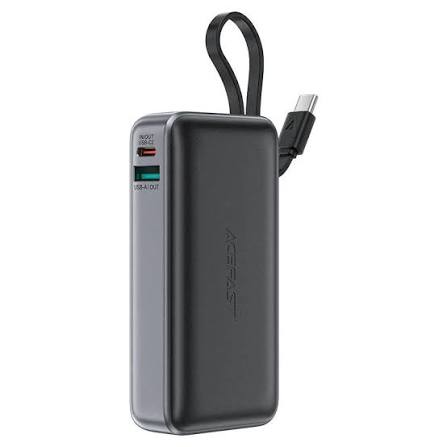
Anker Zolo 10000mAh 30W: For Faster Charging and Built-In Cables
If your priority is reducing the number of accessories you carry every day, the Anker Zolo takes a different approach.
It combines a 10000mAh capacity with up to 30W output and built-in USB-C and Lightning cables according to its specifications on Cart.
That makes it particularly convenient for commuting, work, university, and travel because you do not need to remember a separate charging cable every time you leave home.
Having different built-in connectors can also be useful if you regularly carry different devices.
However, do not choose it based on 30W alone. First make sure your device can take advantage of the available power and charging protocol.
View Anker Zolo 10000mAh 30W on Cart
Comparing 10000mAh Power Bank Options
|
Power Bank |
Capacity |
Output |
Key Feature |
Best For |
|
Anker PowerCore |
10000mAh |
Up to 22.5W |
USB-C + USB-A |
Everyday use |
|
Anker Zolo |
10000mAh |
Up to 30W |
Built-in cables |
Commuting and fewer cables |
Do not let this table make the decision for you.
If your phone cannot benefit from 30W, the lower-output option may already be sufficient. If you dislike carrying charging cables, the built-in cable could matter more than the difference in wattage.
The best product is the one that solves a real problem in your everyday use.
How to Choose the Best 10000mAh Power Bank
Before buying, check these points:
-
Make sure 10000mAh fits your actual usage.
-
Do not expect the entire nominal capacity to reach your phone.
-
Find out the maximum charging power your phone supports.
-
Check the USB-C output.
-
Review PD, PPS, and Quick Charge compatibility where relevant.
-
Check input wattage to understand how quickly the power bank itself can recharge.
-
Decide whether you prefer wired or magnetic charging.
-
Consider whether a built-in cable would make your daily use easier.
-
Check power distribution if the power bank has multiple outputs.
-
Compare physical size and weight, not just capacity.
-
Decide whether you need a digital display or basic LED indicators are enough.
-
If you travel, check the watt-hour rating and your airline's current policy.
-
Choose a reputable product with clearly stated specifications.
Answering these questions makes comparing different models much easier.
Common Mistakes When Buying a 10000mAh Power Bank
The first mistake is assuming:
10000mAh = Two Full Charges for a 5000mAh Battery
That calculation ignores conversion losses and overall system efficiency.
Another common mistake is confusing capacity with charging speed. A 10000mAh capacity does not tell you whether the power bank charges at 20W or 30W.
Users also frequently focus on output while ignoring input, only to discover that recharging the power bank itself takes longer than expected.
Similarly, do not assume that every magnetic power bank supports Qi2, or that a product with three ports can deliver its maximum single-port output to all three devices simultaneously.
And do not make the highest wattage your goal if your phone cannot benefit from it.
A better decision always starts with your device and how you use it, not the biggest number printed on the product.
When Is a 10000mAh Power Bank Not the Best Choice?
Although 10000mAh is a well-balanced capacity, it is not ideal for everyone.
Choose 20000mAh If:
You spend long periods away from power outlets, regularly charge multiple phones, use a tablet heavily, or want additional capacity for longer trips and demanding use.
The power bank may be larger and heavier, but you gain significantly more stored energy between recharges.
Consider 5000mAh If:
You only need an emergency battery top-up, want the smallest and lightest option possible, or are looking for a compact magnetic battery pack for light use.
There is little reason to carry 10000mAh every day if all you need is enough additional power to get you home.
Where to Buy a 10000mAh Power Bank in Jordan
Before choosing a power bank, do not start with the brand name or the highest wattage.
Compare:
Capacity + Usable Energy + Output + Protocols + Input + Size + Features
Then choose the option that matches your phone and everyday routine.
On Cart, you can compare power banks for everyday use, travel, and fast charging, with different capacities, output levels, ports, and designs.
FAQs About 10000mAh Power Banks
Is a 10000mAh Power Bank Good?
Yes. For many smartphone users, 10000mAh provides a practical balance between capacity and portability. However, it may not be enough if you regularly charge multiple devices or spend several days away from a power outlet.
How Many Times Can a 10000mAh Power Bank Charge a Phone?
It depends on the phone's battery capacity, power-bank efficiency, energy conversion losses, and how you use the device while charging. You cannot accurately calculate the number of charges by simply dividing 10000mAh by the phone's battery capacity.
Can a 10000mAh Power Bank Charge a 5000mAh Phone Twice?
Usually not based on that simple calculation. Some energy is lost during voltage conversion and transfer, so the full nominal 10000mAh does not reach the phone's battery.
Why Is the Usable Capacity Lower Than 10000mAh?
The 10000mAh figure represents the nominal capacity of the internal cells. Voltage conversion, power management, and energy transfer introduce natural losses before the energy reaches your device.
10000mAh vs 20000mAh: Which Is Better?
10000mAh is generally better if portability and everyday convenience are your priorities. A 20000mAh model is more suitable if you need additional capacity for multiple devices or longer periods away from a charger.
Is 10000mAh Enough for a Full Day?
For many smartphone users, it can provide a useful amount of backup energy for a full day away from an outlet. The actual result depends on your phone's battery capacity, power consumption, and how you use the power bank.
How Many Watts Should a 10000mAh Power Bank Have?
There is no single wattage that is best for everyone. Choose the output based on the charging power and protocol supported by your phone, not the 10000mAh capacity itself.
Is 20W Enough for a Power Bank?
20W can be sufficient for many compatible smartphones. If your device supports higher charging power, you may benefit from a higher-output model.
Is a 30W Power Bank Better Than a 20W Model?
Only if your device can take advantage of the additional power and the required charging protocols are compatible. A higher number alone does not guarantee faster charging.
Is a 10000mAh Power Bank Good for iPhone?
Yes. Look for appropriate USB-C PD support for compatible iPhones, or consider a compatible magnetic option if you prefer wireless charging. Always check the requirements of your specific iPhone model.
Is a 10000mAh Power Bank Good for Samsung?
Yes, but check the charging power supported by your specific Galaxy model and whether PD/PPS support is required for the charging mode you want to use.
Can a 10000mAh Power Bank Charge a Tablet?
Yes, if the power bank and tablet are compatible. However, tablet batteries are generally larger, so you should expect fewer full charges than with a smartphone.
Can a 10000mAh Power Bank Charge a Laptop?
Some 10000mAh models with suitable USB-C output may provide power to compatible laptops, but the capacity is relatively limited if laptop charging is your main use case. Check both the laptop's power requirements and the power bank's capacity before relying on it.
Is a 10000mAh Power Bank Allowed on a Plane?
A 10000mAh power bank using cells with a nominal voltage of around 3.7V is approximately 37Wh, which is below the commonly used 100Wh threshold for spare lithium batteries. However, airline policies can differ and change, so always check your airline's current rules before traveling.
Is a Magnetic Power Bank Better?
Not necessarily. Magnetic charging is more convenient for some users, while wired charging can offer greater flexibility and efficiency depending on the devices involved. Choose based on your priorities.
What Is the Difference Between MagSafe and Qi2 in a Power Bank?
MagSafe is associated with Apple's magnetic charging ecosystem, while Qi2 is a wireless charging standard that includes magnetic alignment in compatible implementations. Do not assume every magnetic power bank supports Qi2; check the certification and product specifications.
Is Wireless Charging From a Power Bank Slower?
Charging speed and efficiency can differ from wired charging depending on the phone, power bank, wireless charging standard, and temperature. Compare the actual supported output of both methods for the product you are considering.
Is a Built-In Cable Better?
It can be more convenient while commuting or traveling because you do not need to carry a separate cable. A removable cable, however, gives you more flexibility when replacing it or choosing a different connector, length, or power capability.
Can a Power Bank Charge Two Devices at the Same Time?
Yes, if the power bank supports multiple-device charging. However, available power may be distributed between the outputs, so check the total output when multiple ports are being used.
Why Does Charging Slow Down When Two Devices Are Connected?
Because the total available power may be shared between the outputs instead of providing the maximum single-port output to each device.
Is a Digital Display Important on a Power Bank?
It is not necessary for charging, but it can provide a clearer and more precise indication of the remaining battery percentage than traditional LED indicators.
How Long Does It Take to Recharge a 10000mAh Power Bank?
Recharge time depends on the input power supported by the power bank and the charger you use. This is why you should check input wattage rather than judging recharge time from the 10000mAh capacity alone.
Conclusion: Is a 10000mAh Power Bank the Right Choice for You?
If you are looking for the best 10000mAh power bank, do not base your decision on capacity alone.
This category is popular because it strikes an excellent balance between backup power and portability, but individual products can differ significantly in charging speed, supported protocols, ports, physical size, built-in cables, and magnetic charging features.
Start with your actual use case:
Daily Carry → 10000mAh
Fast Charging → Check Wattage + Protocol
Convenience → Built-In Cable or Magnetic Charging
Multiple Devices → Check Ports + Power Distribution
Heavy Use or Multiple Days → Consider 20000mAh
Ultimately, the best power bank is not the one with the biggest number printed on the box. It is the one you can comfortably carry, that provides the charging power your phone can actually use, and that gives you enough backup energy for your day.
Choose based on how you use your devices—not on the numbers alone.